Common Questions & Troubleshooting
Having issues with CleanBrowsing? This guide covers the most common questions and troubleshooting steps to help you resolve configuration problems quickly.
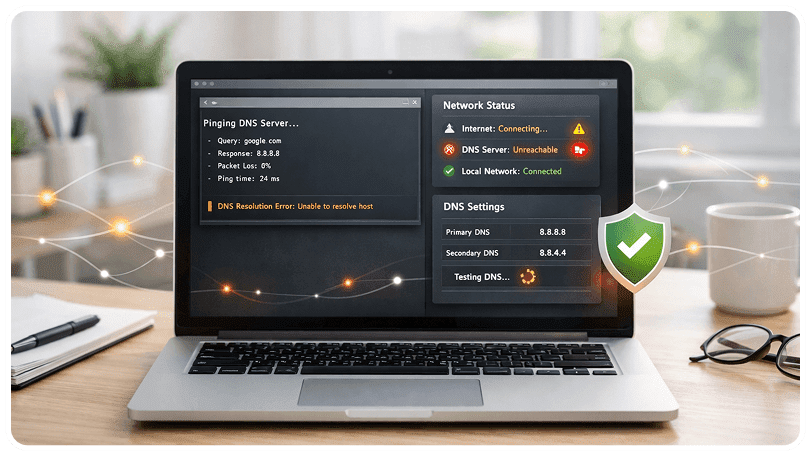
Having issues with CleanBrowsing? This guide covers the most common questions and troubleshooting steps to help you resolve configuration problems quickly.
When reaching out for support, it helps to have the following information ready:
Router Issues: DNS configuration must be set in the Wide Area Network (WAN) settings to cover your entire network. Check our router guides for model-specific instructions.
Device Issues: The most common mistake involves configuring the wrong network interface. Also, ensure you are not mixing Free and Paid DNS addresses — they use different IP addresses.
To verify which filter you are using, run:
nslookup -type=txt iptest.whois.dnscontest.cleanbrowsing.org 185.228.168.10The response will reveal which CleanBrowsing filter version is active. You can also run nslookup -type=TXT mylocation.whois.dnscontest.cleanbrowsing.org 185.228.168.10 to check the server location.
Your ISP or antivirus software may be intercepting DNS queries. Test this by running:
nslookup badexample.com 185.228.168.10The expected result is: server can't find badexample.com: NXDOMAIN
If you receive an IP address instead, something is hijacking your DNS. Common culprits include:
Many modern devices default to IPv6. If you only configured IPv4 DNS, your device may bypass CleanBrowsing entirely.
CleanBrowsing offers IPv6 alternatives for free filters and supports IPv6 activation on paid plans through the dashboard. Make sure to configure both IPv4 and IPv6 DNS settings.
Sometimes problems stem from incompatible routers, unusual network topology, or ISP restrictions that require prior authorization before DNS changes can take effect.
If you suspect a network-level issue, try configuring DNS directly on a single device first to rule out router problems.
Some ISP-provided routers prevent DNS modifications entirely. If your router does not allow you to change DNS settings, check our generic router guide for workaround options, or configure DNS directly on individual devices instead.
If you recently changed filter settings in your dashboard (enabled/disabled a category, added domains to your block or allow list) but the changes do not seem to be working, the most likely cause is propagation time.
Dashboard changes take 30 to 45 minutes to propagate across CleanBrowsing's resolver network. During this window, your old filter rules are still active.
If you enable a content category (e.g., "Video Streaming"), there is no need to also add individual domains like netflix.com or hulu.com to your custom block list. The category already covers those domains. Adding them to the custom block list on top of the category does not improve filtering — it can actually complicate things if you later want to make an exception for a specific domain.
Use custom block lists only for domains that are not covered by any predefined category.
If inappropriate content bypasses detection, please report it to support@cleanbrowsing.org so we can improve our filtering systems.
For persistent issues, our support team can arrange a screen-sharing session for hands-on troubleshooting.
Clear DNS cache on Windows, macOS, and Linux.
Clear DNS cache in Chrome, Firefox, Safari, and more.
Universal guide for configuring DNS on most routers.
If you have tried the steps above and are still experiencing issues, contact our support team for personalized assistance.
 Contact Support