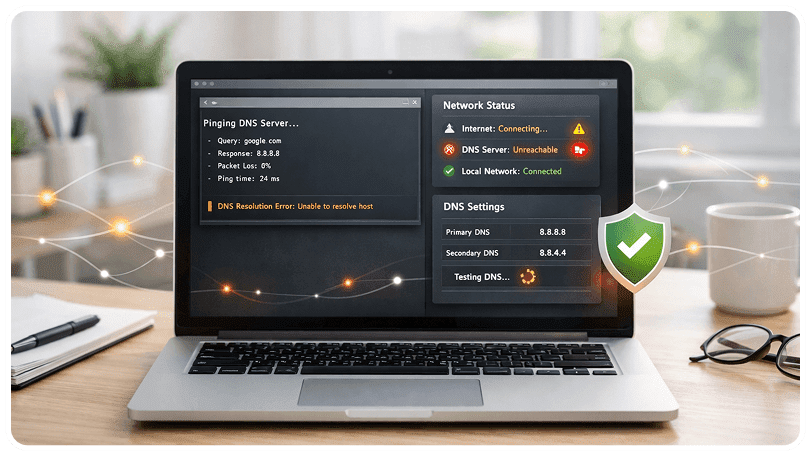
DNS-based content filtering works by intercepting domain name lookups and blocking access to domains in restricted categories. This is effective, lightweight, and easy to deploy — but it has a fundamental dependency: the device must actually use your DNS resolver. If a user can send their DNS queries to a different server, or tunnel them through an encrypted connection, the filter is bypassed entirely.
Users bypass DNS filtering in three primary ways, each exploiting a different weakness:
- Changing local DNS settings: The simplest method. A user manually sets their device's DNS to a non-filtering resolver like Google (
8.8.8.8) or Cloudflare (1.1.1.1). This overrides the DNS server provided by your router via DHCP, and all queries go to the alternate resolver — unfiltered. - DNS-over-HTTPS (DoH) or DNS-over-TLS (DoT): These encrypted DNS protocols send DNS queries through encrypted channels to a resolver of the user's choice. Because the queries are encrypted, your network cannot inspect or redirect them. Modern browsers like Firefox and Chrome have built-in DoH support that can be enabled with a few clicks.
- VPN connections: A VPN creates an encrypted tunnel that carries all traffic — including DNS — through a remote server. The VPN provider's DNS resolver handles lookups inside the tunnel, completely bypassing your network's DNS configuration.
Each method requires a different mitigation strategy. The following steps address each one individually, from the simplest to block (local DNS changes) to the most challenging (VPNs).